
How to Benchmark Your Finger Strength
Most climbers test their fingers the same way: they have a good day on the board, feel strong, and decide their training is working. Then they have a bad day and decide it isn't.
A benchmark fixes that. It doesn't need to be fancy. It needs to be the same every time.
A Simple Max Hang Test
Here's a test that works for most people who are already hangboarding:
- Warm up properly. Easy climbing, then a few progressively harder hangs.
- Pick one edge, 20mm is a common choice, and one grip, half crimp or open hand.
- Hang for 10 seconds with as much added weight as you can manage with good form. Use a pulley and take weight off if bodyweight is too hard.
- Rest three minutes between attempts. Take your best of three.
Record your bodyweight on the day as well as the added weight. Total load as a percentage of bodyweight is a fairer comparison over a season than added weight on its own.
Keep It Comparable
This is where most testing falls apart. A result is only useful if you can compare it to the last one, which means the same edge, the same grip, the same hang time, roughly the same time of day, and not straight after a hard session.
If you change something, like moving from a 20mm to an 18mm edge, that's fine. Just don't pretend the numbers are on the same line.
How Often
Every four to eight weeks is plenty. Test at the start and end of a training block, and you'll know whether the block did what you wanted. Test more often than that and you mostly measure how well you slept.
Doing This in Sequence
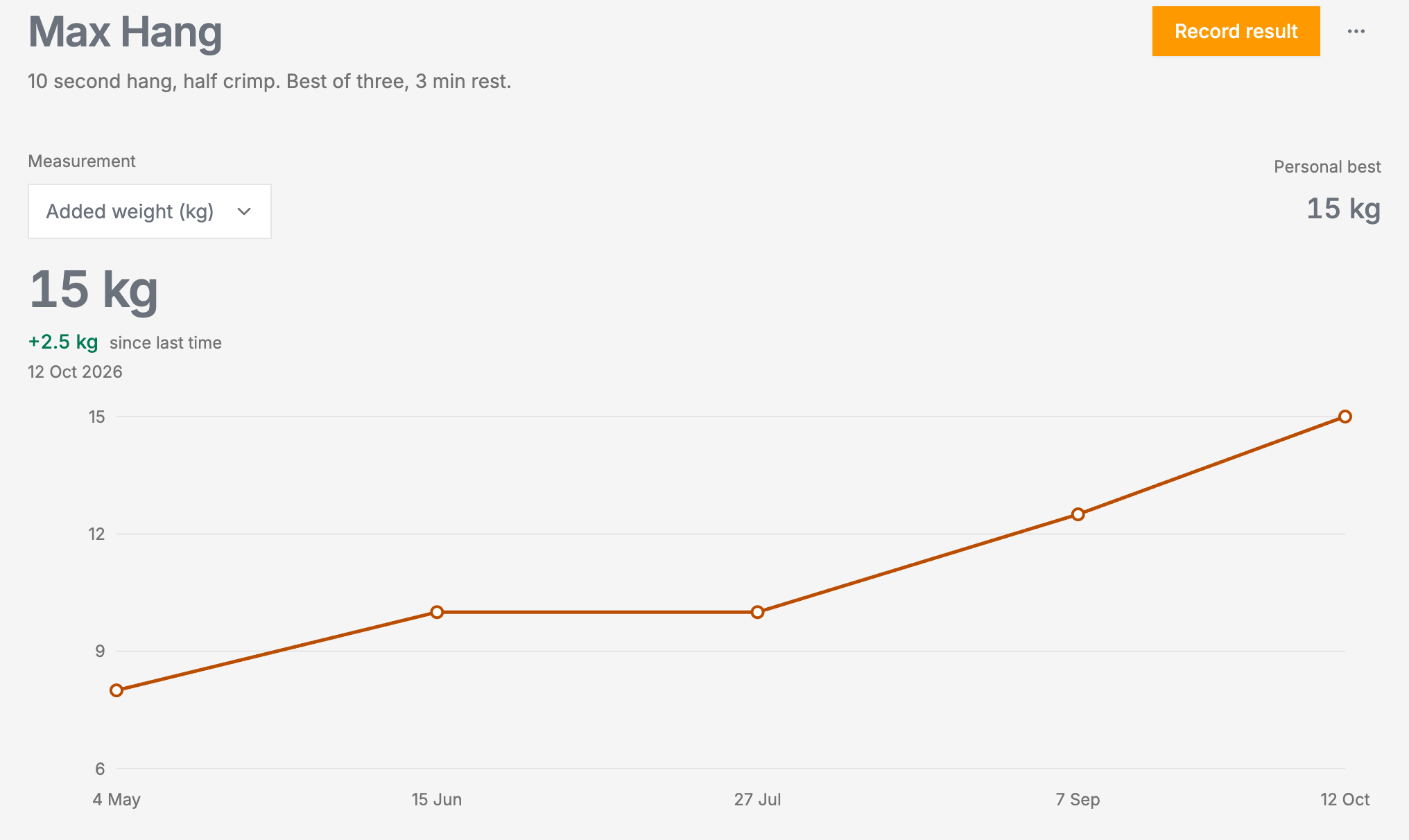
Sequence lets you build your own tests, so you can set this one up once and run it the same way every time. Add fields for edge size, grip, added weight, and bodyweight, and mark which direction counts as progress for each one. More weight is better. A smaller edge is better.
Schedule it on your planner at the end of each block and record the result on your phone at the board. Each test then shows a graph of your results over time with your personal best called out, and every new result is compared against the last. If you changed the edge, Sequence tells you the results aren't comparable rather than drawing a misleading line.
The same works for anything you want to benchmark: a max pull-up, a campus ladder, a timed hang to failure, or your benchmark problem on the board.
Train, test, and let the numbers settle the argument your good days and bad days keep having.